
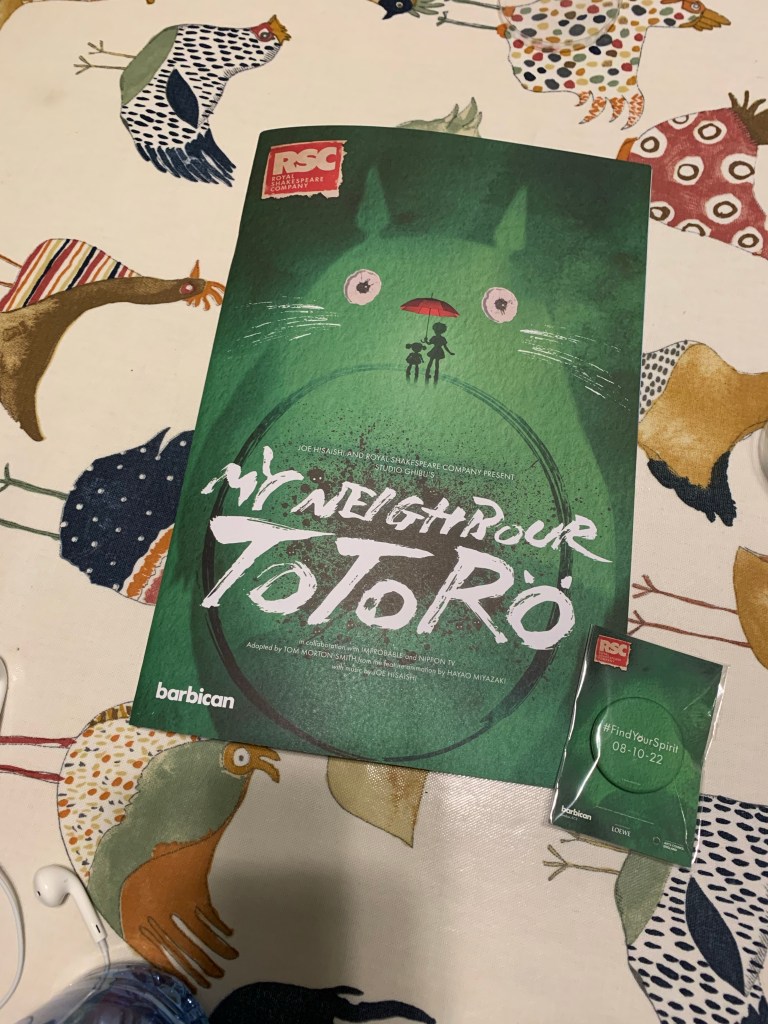
It’s been a longtime since I’ve been to the theatre in person. I took my girlfriend to see The Woman In Black in 2019 as I wanted to give her a unique theatrical experience before she went home to South Korea. Last Saturday, I went to the opening performance of My Neighbour Totoro at The Barbican produced by The Royal Shakespeare Company; and I dearly wished she could’ve been with me this time around as it is one of the most staggering pieces of theatre I’ve ever seen.
It takes a lot of work to standout and make an impact in the very crowded market that is London theatre. In addition, you’re adapting perhaps one of the most beloved anime films of all-time with an ardent fanbase that is never shy about expressing their opinion. That and (with a few exceptions) western adaptations of manga and anime don’t exactly have the best track record (for every Alita: Battle Angel, there’s a Death Note or Dragon Ball Evolution). You could definitely argue that this perception would give the production a huge handicap right from the get go.
Fortunately, this play already has a big boost by all the talented people involved in its creation. You have the original film’s composer Joe Hisaishi composing the music and overseeing the production as a producer, the behemoth that is The Royal Shakespeare Company handling production and puppets from The Jim Henson Creature Shop. With names like these, you’d naturally assume you’d be in safe hands and Studio Ghibli are usually very careful with their properties. Nevertheless, I did still have that little niggling bit of concern in the back of my head. Even with the best of intentions, this is an iconic film and I could never imagine Hayao Miyazaki’s vision translating to theatre. But I love it when I’m proved wrong; and this production had me within seconds with both a nice establishment of British spelling and creepy crawlies spreading around the curtain replicating the film’s opening credits. The charm level is off the wall before the main players even arrive.
I won’t bore with a complete recap, but Tom Morton-Smith’s adaption directed by Phelim McDermott closely follows the plot of the film where a father working in academia moves to the countryside with his two daughters Satsuki and Mei whilst they await the arrival of their mother who is being treated in hospital for a serious illness. The two girls subsequently discover many mysterious creatures living in the woods nearby. It’s not a shot-by-shot remake which was never the intention, but the play shares the same message and destination.
The predominately Asian cast is packed with energy and does a great job at immersing you into this rural Japanese community. The lion’s share of the acting is from the two leads Satsuki and Mei played by Ami Okumura Jones and Mei Mac respectively. Whilst both are young, they are definitely much older than the characters they are portraying. I know this isn’t uncommon in theatre, but I did have a little apprehension going in as childhood is such a large part of the original film and I thought I might find it distracting. But once again, I love being proven wrong as both actresses carry the show with boundless energy and passion. I can’t count the amount of times I was grinning from ear-to-ear because of these two, whether they were running around cleaning a house full of soot sprites or helping Totoro grow plants. It all felt very authentic, especially when their cheerfulness is pushed aside as the reality of their mother’s condition settles in. There is a real chemistry between the two which is essential for this story.
Staging wise, it has a traditional Japanese vibe mixed with nature. The puppeteers regularly create moments that enhance the immersive atmosphere like becoming a swarm of soot sprites or rows of a corn field. An impressive old style Japanese house is the biggest set piece whilst the vines and trees create a balcony above the stage where the orchestra and singer perform.
Whilst we’re on the subject, the music is as fantastic as you’d expect. Hisaishi revisits many of his classic pieces from the film’s original score and it translates just as well to stage. Singer Ai Ninomiya has a wonderfully calming voice that is well suited to this production and she nails the signature theme song that is now stuck in my head once again.
Back to production though, one of the biggest questions fans had was how Totoro and his friends would be depicted. Well I can tell you that the puppets are incredible, though when you have the pedigree of the Jim Henson Creature Shop, that shouldn’t be surprising. The moment the two mini Totoro’s appeared, the audience were in hysterics. Not only because they were adorable, but because of the tremendous job the puppeteers did with their movements. The way they moved their feet always cracked me up. The Catbus was also shockingly impressive. It was one of the things I thought would be tough to translate to stage, but it was massive, had glowing eyes and flew around on stage which is all I could ask for.
But the main event was obviously Totoro himself. The audience was in a state of fever pitch as it got to the part where they knew Totoro would be making his first appearance. I’m going to show my age here, but it reminded me of the start of the 1990 Teenage Mutant Ninja Turtles film when the turtles were about to jump around the corner after their shrouded opening battle and be seen in live action for the first time (by coincidence, those costumes were also designed by the Jim Henson Creature Shop). Then the moment came, there was an audible gasp and then all the audience broke into rapturous applause for the first of many times. I don’t think I’ve ever seen a more alive looking puppet in film, let alone on stage – and that’s even with the puppeteers visible. Totoro looks like he’s leapt off the screen fur and all. Every part of him individually moves thanks to a host of puppeteers, from his eyes to his arms. And when he roars, it is a sight to behold. Special credit again to Jones and Mac who engage with this wonderful creature in such an enthralling way. Those iconic moments when Mei lies on his belly and Satsuki lends him an umbrella at the bus stop could not have been done better.
When the play was over and that ear worm of a theme song was playing, the crowd was giving it a standing ovation, myself included. Upon returning home, I decided I immediately had to see it again and got to booking another ticket. It has a limited run until 21 January of next year, so I suggest anyone sitting on the fence grabs a ticket whilst they can. I’m definitely confident though that this production will have a long life beyond this run.
It not only satisfied the anime fanboy in me, but made me feel like a child again (as cheesy as it sounds) as I got completely lost in the show. The words whimsical and magical are avoided in my line of work, seen as cliché. But it’s impossible not to use them at least once when describing the experience of seeing My Neighbour Totoro on stage.

My Neighbour Totoro is running at The Barbican from 8 October 2022 to 21 January 2023.
 Leopard on Comics